Custom AI Chatbot Development Services: Cost, Process, and Real Benchmarks for 2026
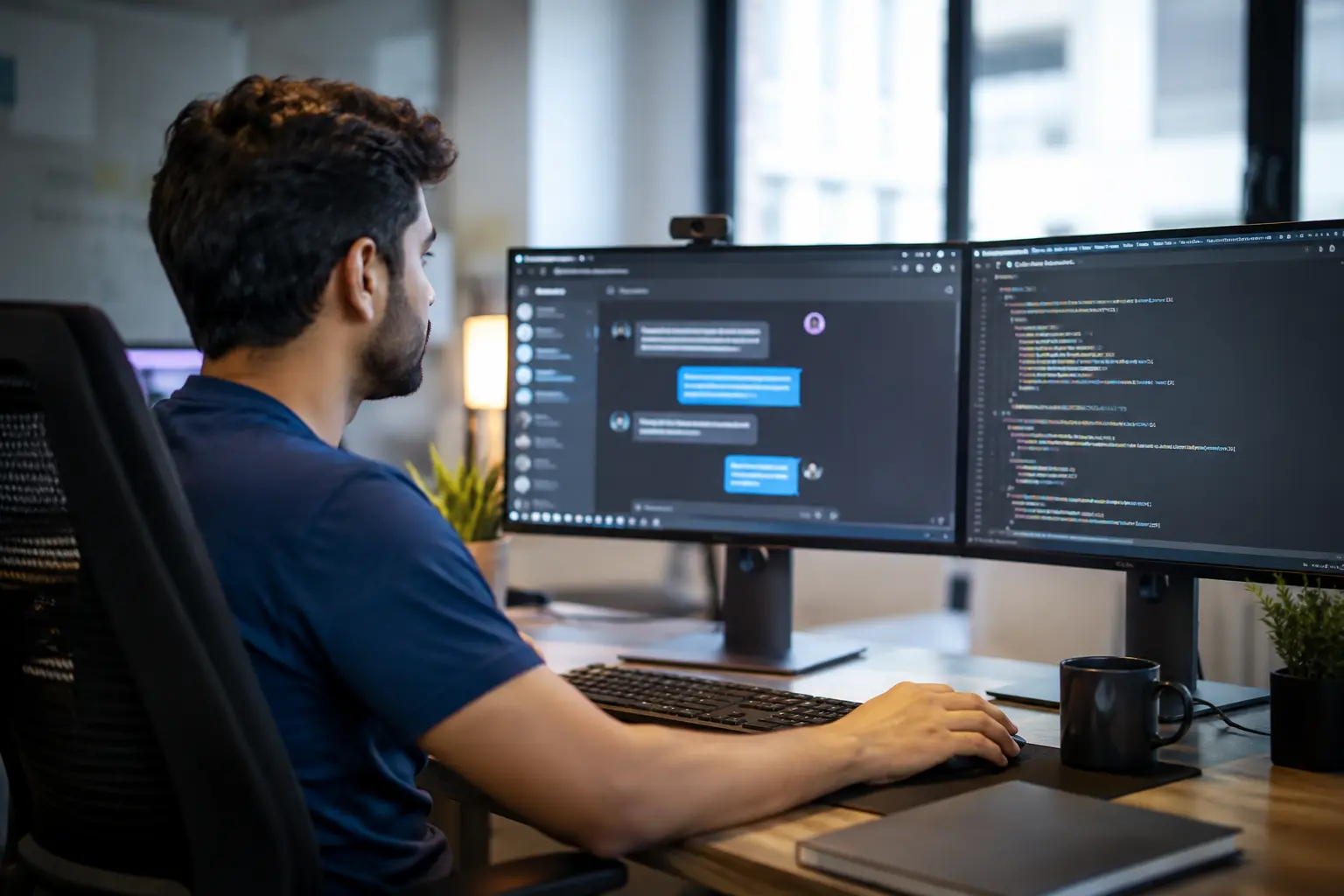
Custom AI chatbot development services build a conversational AI trained on your own data and connected to your systems. This guide breaks down real 2026 pricing, Gartner and Forrester containment benchmarks, RAG architecture, and how to choose between custom and off the shelf tools.
FAST ANSWER: Custom AI chatbot development services build a conversational AI system trained on your own business data and connected to your systems, instead of a generic template bot. Costs range from $3,000 for a basic FAQ bot to $150,000+ for enterprise deployments, with most mid sized projects landing between $15,000 and $50,000 and shipping in 6 to 12 weeks. According to Gartner's 2025 Customer Service Technology Survey, well built RAG based bots average 40 to 65 percent containment, with best in class deployments reaching 70 to 90 percent.
What Custom AI Chatbot Development Services Actually Are
A custom AI chatbot is not the same thing as the pop up widget you get from a $29 a month SaaS tool. Custom development means the chatbot is built around your own knowledge base, your own conversation logic, and your own systems, using large language models (LLMs), natural language processing (NLP), and retrieval augmented generation (RAG) so it answers using your actual product data instead of guessing.
At DifusionSEO, we build these systems as part of our AI Automation Solutions, combining OpenAI and LangChain based architectures with the same full stack engineering discipline we use on React, Django, and Node.js projects. The chatbot is only as good as the pipeline behind it, meaning how the data is ingested, how the model retrieves it, and how the responses are tested before launch.
Why Most Chatbot Projects Underperform Before They Even Launch
The single biggest reason a custom chatbot underperforms has nothing to do with the LLM. It is a disorganized or incomplete knowledge base. If your refund policy lives in an outdated internal doc and your product descriptions are inconsistent across your website and CRM, the bot inherits those errors and answers confidently with wrong information. This is why every serious build starts with a data audit before a single line of orchestration code is written, and why vendors who skip discovery and jump straight to connecting an LLM tend to ship bots that get replaced within a year.
Custom AI Chatbot vs Off the Shelf Chatbot Platforms
Most businesses start here, deciding whether a template tool is enough or whether the project needs a custom build.
|
Factor |
Off the Shelf (Intercom, Tidio, Drift) |
Custom AI Chatbot Development |
|
Setup cost |
$0 to $500 |
$3,000 to $150,000+ |
|
Monthly cost |
$29 to $0.99 per resolved conversation |
Hosting plus LLM API usage, often $200 to $3,000/month |
|
Knowledge source |
Pre built templates, limited uploads |
Your own docs, CRM, database, product catalog |
|
Write back actions |
Usually limited to ticket creation |
Refunds, bookings, CRM updates, order changes |
|
Best fit |
Under 200 help articles, mostly FAQ traffic |
Proprietary data, CRM write back actions, compliance needs |
|
Ownership |
Rented, tied to vendor pricing per resolved chat |
Fully owned, no per seat or per conversation lock in |
|
Time to launch |
1 to 2 weeks |
6 to 12 weeks average |
If your support volume is under 5,000 conversations a month and your ticket mix is 80 percent FAQ, a SaaS tool usually wins on cost. Custom development pays off once you need write back actions the packaged tool cannot support, multiple conversation surfaces, or a compliance requirement such as GDPR data residency that an off the shelf vendor cannot meet.
The Modern Custom Chatbot Stack
A production grade custom chatbot in 2026 is typically built from four layers, and understanding them helps you ask better questions when scoping a project.
Foundation Model Layer
Most builds mix two models rather than relying on one. A smaller, cheaper model handles intent classification and routing, while a larger reasoning model generates the actual answer. This keeps per conversation API cost down without sacrificing answer quality on complex queries.
Orchestration Layer
Frameworks like LangChain or LlamaIndex manage the flow between the user's message, the retrieval step, and the model call. This is the glue that decides when the bot searches your knowledge base versus when it calls an API to check an order status.
Retrieval and Vector Database Layer
This is where RAG happens. Your documents, product catalog, and policies are converted into embeddings and stored in a vector database such as Pinecone, Weaviate, or pgvector. When a user asks a question, the system retrieves the most relevant chunks of your actual content before the model writes a response. Retrieval quality here is the single biggest lever on accuracy, more than model choice.
Integration Layer
REST APIs and webhooks connect the bot to your CRM, helpdesk, payment gateway, or ERP so it can read and write data, not just answer questions.
Why RAG Matters More Than the Model You Choose
A standalone LLM answering purely from training data hallucinates far more often than one grounded in your actual documents. A February 2026 industry analysis covering 847 production deployments, published by a consortium of enterprise AI vendors, found that RAG pipelines reduced hallucination rates by a median of 71 percent on domain specific queries compared to the same model running without retrieval, with results ranging from 58 to 89 percent depending on retrieval corpus quality. In practice this means two chatbots running the identical foundation model can perform very differently depending entirely on how clean and well chunked their knowledge base is. This is also why a chatbot's accuracy tends to degrade over time if nobody maintains the source documents. A pricing page that changes without the vector database being reindexed will cause the bot to quote outdated numbers with full confidence.
What a Custom AI Chatbot Development Project Includes
Data and Knowledge Base Audit
Before development starts, the source data gets audited for consistency and completeness. This phase typically takes 1 to 2 weeks on a mid sized project and is the phase most likely to reveal scope creep.
NLP, LLM Integration, and RAG Architecture
The model gets connected to your knowledge base through the vector database described above. Response accuracy on well audited, narrow scope data sets typically lands above 90 percent, while broader, less curated knowledge bases see more variance.
CRM, ERP, and API Integrations
A chatbot with no system access is a smarter FAQ page. Real operational value comes from write back actions, such as checking order status, updating a lead record, or booking an appointment without a human touching it. Integration work is consistently the largest single line item in a project's hours, often 20 to 40 percent of total build time.
Multichannel Deployment
Website widget, WhatsApp, Slack, or an internal portal. Each surface has different latency and formatting constraints. A bot tuned for a website widget usually needs prompt and response length adjustments before it performs well on WhatsApp, where users expect shorter, punchier replies.
Security and Compliance
Every chatbot that touches customer data needs input validation, rate limiting, and prompt injection defenses. The OWASP Top 10 for Large Language Model Applications is the standard reference for the most common LLM specific vulnerabilities, covering risks such as prompt injection, insecure output handling, and excessive agency where a bot is granted more system access than its use case actually requires. For organizations that need a formal risk process, the NIST AI Risk Management Framework provides a voluntary structure many enterprise procurement teams now ask vendors to reference directly.
Custom AI Chatbot Development Cost in 2026
|
Tier |
Price Range |
What's Included |
Typical Timeline |
|
Basic |
$3,000 to $15,000 |
Single surface FAQ or lead qualification bot, no write back actions |
2 to 4 weeks |
|
Mid level |
$15,000 to $50,000 |
Multi intent bot, one CRM or helpdesk integration, live agent handoff |
6 to 10 weeks |
|
Enterprise grade |
$50,000 to $150,000+ |
Multichannel deployment, 5 to 10 write back actions across multiple systems, dedicated security review |
3 to 6 months |
On top of the build, plan for ongoing costs. LLM API usage generally runs $200 to $3,000 a month depending on conversation volume, and a quarterly tuning cycle to keep the bot accurate as your data changes typically costs another $3,000 to $8,000 a year. Budget these separately from the initial build quote, since vendors who bundle them into a single upfront number are usually underestimating one or the other.
The ROI case gets easier to make once you compare cost per resolved conversation. A well tuned RAG chatbot typically resolves a conversation for $0.10 to $0.50, factoring in platform and maintenance cost against monthly resolved volume. Forrester's Total Economic Impact research on AI customer service puts the average human agent cost per interaction at $8.01 for chat and $12.31 for phone in 2025, which is the baseline most businesses use to justify the initial build spend.
How Long Does Custom AI Chatbot Development Take
A focused single use case bot, such as a lead qualification assistant, can launch in 2 to 4 weeks. A mid complexity bot with CRM integration usually takes 6 to 10 weeks, broken roughly into 1 to 2 weeks of discovery, 3 to 6 weeks of core build, and 2 to 3 weeks of integration and hardening before rollout. Enterprise deployments with multiple integrations, compliance review, and multichannel launch run 3 to 6 months. Any vendor quoting a production ready enterprise bot in under three weeks is shipping a demo, not a system that will hold up under real traffic.
How to Measure Chatbot Performance After Launch
Once live, a chatbot should be reviewed against concrete metrics rather than gut feeling. According to Gartner's 2025 Customer Service Technology Survey, organizations running mature RAG deployments average 55 to 65 percent containment, while rule based bots average only 20 to 35 percent.
- Containment rate: the percentage of conversations resolved without a human. A rate under 30 percent after 30 days usually signals an incomplete knowledge base, not a broken model.
- Deflection rate: measures impact on ticket volume rather than conversation outcomes, and is always higher than containment since it includes users who self served before ever opening a ticket. Forrester found strong RAG deployments achieve 40 to 55 percent ticket deflection within 90 days of launch.
- First contact resolution (FCR): Salesforce's State of Service research found teams with FCR rates of 60 percent or higher reported 23 percent lower overall support costs compared to teams whose bots primarily triaged rather than resolved.
- Ticket reopen rate: the percentage of bot resolved conversations where the user returns with the same issue. Above 8 percent signals the bot is closing conversations prematurely rather than solving them, a distinction containment rate alone will not catch.
- Cost per resolved conversation: the number that ties the whole investment back to ROI, typically $0.10 to $0.50 for a well tuned deployment.
Treat a containment rate above roughly 85 to 90 percent with suspicion rather than celebration. For most support use cases, 70 to 75 percent is a strong ceiling, not a floor you are failing to hit. Bots pushed past that are often trapping customers in loops rather than genuinely resolving issues, which the ticket reopen rate will eventually expose.
Signs You Need Custom Over Off the Shelf
-
Your knowledge base exceeds 200 articles or spans multiple systems that a template tool cannot ingest cleanly
- You need the bot to write to your CRM or ERP, not just read from a help center
- You operate under GDPR, HIPAA, or a data residency requirement your SaaS vendor cannot guarantee
- You need the bot live on more than one surface, such as website plus WhatsApp plus an internal portal
- Your support volume exceeds roughly 5,000 conversations a month and per resolved conversation SaaS pricing is starting to outpace what a custom build would cost annually
How DifusionSEO Approaches These Projects
Every engagement starts the same way regardless of industry: a knowledge base and systems audit before any model gets touched, because the research above is consistent on this point, a bot is only as accurate as the data it retrieves from. From there our process mirrors the phases in this guide, discovery and data cleanup first, core RAG build second, integrations and write back actions third, then a hardening phase where we run the bot in shadow mode against real queries before full rollout. Because DifusionSEO also builds and operates LeadNexus, its own B2B lead generation and outreach automation SaaS, the same automation and API integration patterns used in chatbot projects are ones the team maintains on a live product every day, not just something quoted from a case study.
DifusionSEO combines this AI automation work with full stack development in React, Django, and Node.js through its Web Development practice, and secures what it builds through its Cyber Security Solutions team, all under one roof rather than outsourced across three separate vendors. For accessibility of any chatbot widget deployed on a public site, builds follow the W3C Web Content Accessibility Guidelines (WCAG) so keyboard and screen reader users are not locked out of the conversation.
If you are weighing a custom build against a SaaS tool, earlier breakdowns on what an AI automation consultant actually costs and how to choose the right business automation service cover the adjacent decisions in more depth.
FAQs
What are custom AI chatbot development services?
They are end to end services covering planning, design, LLM integration, system connections, and ongoing maintenance of a chatbot built specifically around one company's data and workflows, rather than a generic plug and play tool.
How much does custom AI chatbot development cost?
Pricing typically ranges from $3,000 for a basic FAQ bot to $150,000+ for enterprise deployments, with most mid sized business projects landing between $15,000 and $50,000.
What's the difference between a custom chatbot and an off the shelf chatbot?
Off the shelf tools work fast and cheap for simple FAQ volume under 5,000 conversations a month. Custom chatbots are built when you need proprietary data, CRM write back actions, or compliance requirements a packaged tool cannot meet.
How long does AI chatbot development take?
A focused MVP can launch in 2 to 4 weeks. Mid complexity builds with integrations take 6 to 10 weeks, and enterprise projects run 3 to 6 months.
Can the chatbot integrate with our CRM or ERP?
Yes, custom chatbots are commonly connected to CRMs, ERPs, payment gateways, and ticketing systems through APIs so they can retrieve or update data during a live conversation. This integration work is usually the largest single portion of the build hours.
How is chatbot performance measured after launch?
Through containment rate, deflection rate, first contact resolution, ticket reopen rate, and cost per resolved conversation, reviewed on a regular cycle rather than a one time check.
What are the ongoing maintenance costs?
Expect $200 to $3,000 a month in LLM API usage plus $3,000 to $8,000 a year for a quarterly tuning and retraining cycle as your data and customer questions evolve.
Which LLMs and frameworks are typically used?
Most custom builds pair a foundation model such as GPT class or Claude class models with an orchestration framework like LangChain, and a vector database such as Pinecone or Weaviate for retrieval augmented generation, though the right stack depends on latency, cost, and data residency needs.
What is RAG and why does a chatbot need it?
Retrieval augmented generation lets the model answer from your actual documents instead of relying only on its training data. Well implemented RAG cuts hallucination substantially, with a 2026 industry analysis finding a median 71 percent reduction, and lets you update the bot's knowledge by updating your documents rather than retraining the model.
What is considered a good containment rate?
Gartner's 2025 benchmark data puts mature RAG deployments at 55 to 65 percent average containment, with best in class implementations reaching 70 to 90 percent. A rate above roughly 85 to 90 percent should be treated with suspicion, since it often means the bot is closing conversations without genuinely resolving them.
Ready to Build a Chatbot That Actually Knows Your Business?
If you are comparing custom development against a SaaS tool, or you already know you need a bot trained on your own data and connected to your systems, our team can scope it properly before you commit budget. Get in touch with DifusionSEO for a free consultation and project quote, or message us directly on WhatsApp to talk through your use case.
Discussion (0)
Leave a Comment
No comments yet. Be the first to start the discussion!
Related Insights.

Business Process Automation Consultant: Role, Cost, and How to Hire One
A business process automation consultant maps manual workflows and builds the systems to automate them. This guide covers what they actually do, how their cost compares across freelance, agency, and in house hiring, and how the role differs from an RPA consultant.
Intelligent Automation Consulting Services: The Complete Guide to Cost, Process, and Choosing a Partner
Intelligent automation consulting services combine process discovery, RPA, and AI to replace manual workflows with monitored systems. This complete guide covers real pricing tiers, the six step delivery process, RPA vs AI, and a practical checklist for choosing the right partner.

Business Process Automation Consulting: How It Works and How to Choose a Partner
Business process automation consulting turns manual, repetitive workflows into live, monitored automations, not just a strategy document. Here is what the engagement actually involves, what it costs, and how to choose the right partner.